Model vs market
Find where the model disagrees with the market.
Compare pre-fight model probabilities with the market, explore fighter Style DNA, and track walk-forward performance across UFC events.
Upcoming EventPredictions & odds updated Oct 18 · 08:31 UTC
11
Fights
▼
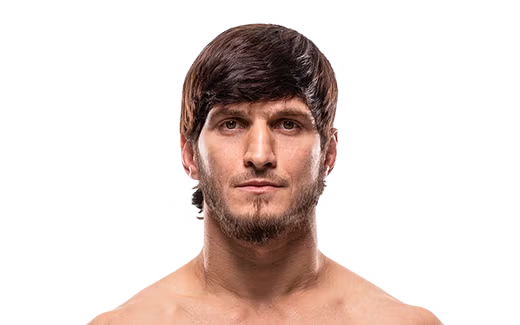
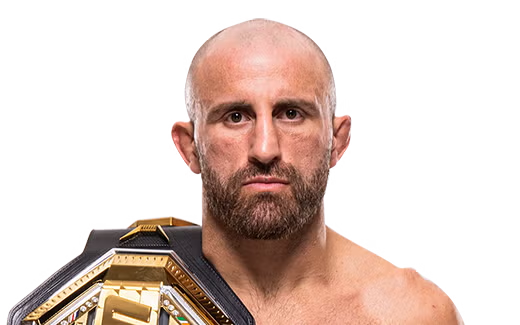
established · 10 UFC fightsestablished · 10 fights
Style Matchup
STRIKING
P83
Striking Initiative
P94
P56
Volume
P79
P60
Striking Efficiency
P90
P20
Range Sniper
P71
P42
Kickboxing
P76
P29
Clinch Striking
P30
P78
Defensive Striking
P71
GRAPPLING / WRESTLING
P99
Wrestling
P58
P86
Pressure Wrestling
P55
P90
Top Control
P72
P31
Submission
P25
P76
Anti-Wrestling
P97
P54
Grappling Defense
P90
P59
Scrambler
P57
DAMAGE / FINISHING
P7
Power
P66
P0
Finisher
P20
P95
Damage Resistance
P67
· style, not skillFIGHT DYNAMICS· style, not skill
P74
Fast Starter
P67
P96
Pace
P90
P94
Late Fighter
P88
GLOBAL
P97
Versatility
P99
Current fighter profiles · percentiles vs current established UFC fighters (8+ fights).
Striking
EvloevVolkanovski
3.91Landed / min5.99
2.80Absorbed / min3.31
48%Accuracy57%
61%Defense59%
0.00KD / 150.30
0.00KD abs / 150.20
Grappling / Wrestling
EvloevVolkanovski
4.78TD / 151.63
9.09TD att / 154.80
53%TD accuracy34%
61%TD defense69%
5:21Control / 152:58
0.19Sub att / 150.20
Targets
EvloevVolkanovski
Head77%|65%
Body15%|10%
Leg8%|25%
Position
EvloevVolkanovski
Distance75%|76%
Clinch8%|8%
Ground17%|15%
Ranking evolution Evloev Volkanovski
AI Matchup Analysis
Generated by an LLM from structured matchup data. It does not determine the model's win probability.
Movsar Evloev
Evloev comes in unbeaten at 20-0 overall and 10-0 in the UFC, riding a 20-fight win streak with his last win over the No. 7-ranked opponent. His edge lives in the grappling: a strong push to get the fight down, control from top, and a gas tank that holds up deep. His mat work has been trending upward.
Alexander Volkanovski
Volkanovski owns a 28-4 record and a deep résumé, most recently beating the No. 3-ranked opponent while his last loss came to the No. 4-ranked fighter. His game leans on striking volume and sustained pressure, with the better knack for closing the show before the scorecards. His defensive work has been sharpening.
Matchup Read
Evloev's drive to put the fight on the mat meets Volkanovski's striking pressure, and that collision defines it. If Evloev lands his takedowns and leans on his top control, he drags the fight into his best phase and blunts the standup. If Volkanovski keeps it upright with his volume, he banks rounds and his finishing threat grows. Cardio leans Evloev's way late, while Volkanovski carries the sharper path to a stoppage.
What to Watch
- Grappling: whether Evloev's level changes land clean or Volkanovski keeps the fight standing and forces striking exchanges.
- Early striking: how much volume Volkanovski puts on before any level change, and whether he threatens the finish.
- Late rounds: whether Evloev's deeper gas tank starts showing as the fight stretches out.
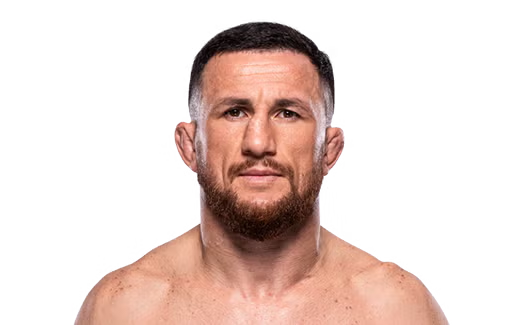
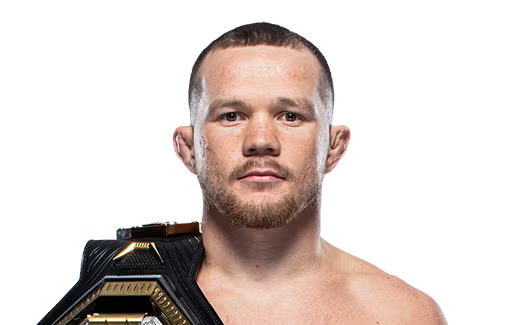
established · 17 UFC fightsestablished · 17 fights
Style Matchup
established · 16 UFC fightsestablished · 16 fights
STRIKING
P88
Striking Initiative
P86
P66
Volume
P71
P29
Striking Efficiency
P95
P14
Range Sniper
P84
P27
Kickboxing
P82
P69
Clinch Striking
P72
P36
Defensive Striking
P76
GRAPPLING / WRESTLING
P95
Wrestling
P66
P99
Pressure Wrestling
P57
P95
Top Control
P52
P27
Submission
P13
P86
Anti-Wrestling
P82
P95
Grappling Defense
P99
P63
Scrambler
P53
DAMAGE / FINISHING
P13
Power
P64
P2
Finisher
P4
P98
Damage Resistance
P99
· style, not skillFIGHT DYNAMICS· style, not skill
P76
Fast Starter
P71
P100
Pace
P57
P32
Late Fighter
P90
GLOBAL
P83
Versatility
P99
Current fighter profiles · percentiles vs current established UFC fighters (8+ fights).
Striking
DvalishviliYan
4.42Landed / min5.16
2.80Absorbed / min4.24
42%Accuracy55%
54%Defense60%
0.05KD / 150.53
0.05KD abs / 150.05
Grappling / Wrestling
DvalishviliYan
5.97TD / 151.70
16.95TD att / 153.46
35%TD accuracy49%
76%TD defense86%
5:23Control / 152:15
0.35Sub att / 150.11
Targets
DvalishviliYan
Head67%|69%
Body17%|19%
Leg16%|12%
Position
DvalishviliYan
Distance64%|75%
Clinch15%|12%
Ground21%|13%
Ranking evolution Dvalishvili Yan
AI Matchup Analysis
Generated by an LLM from structured matchup data. It does not determine the model's win probability.
Merab Dvalishvili
Dvalishvili brings the more dangerous recent submission threat and a solid top game once he gets the fight to the mat. He manages range and defends stand-up exchanges a touch better, and he's shown a sturdy chin. His last win came over the No. 5-ranked opponent, part of a 21-5 overall mark.
Petr Yan
Yan rides a four-fight win streak capped by a victory over the No. 1-ranked opponent, with a 20-5 record across all organizations. His defensive work has been trending upward recently, his cardio holds up well into the later rounds, and he carries a bit more pop to finish before the scorecards.
Matchup Read
Yan's finishing threat makes the opening rounds his best window, while Dvalishvili's late-round value grows if he can drag this into the trenches. The fight turns on whether Dvalishvili closes distance and converts his top game and submission threat against Yan's improving defense, or whether Yan keeps it standing and lets his pace and output accumulate. Yan's switch stance reshapes the angles on entries. Durability may keep Dvalishvili in deep exchanges longer.
What to Watch
- Early striking: whether Yan can keep the fight at range and land the heavier shots before Dvalishvili ties him up.
- Grappling: how often Dvalishvili reaches the mat and whether his top control holds long enough to hunt submissions.
- Late rounds: whether Yan's pace stays sharp or Dvalishvili's volume and chin take over the back half.
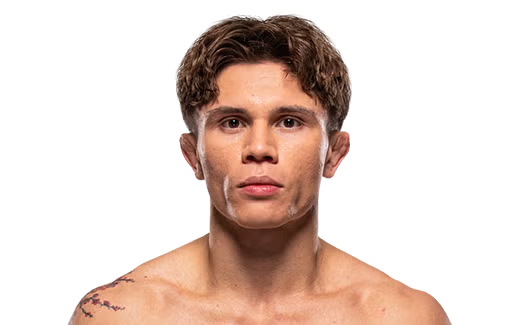
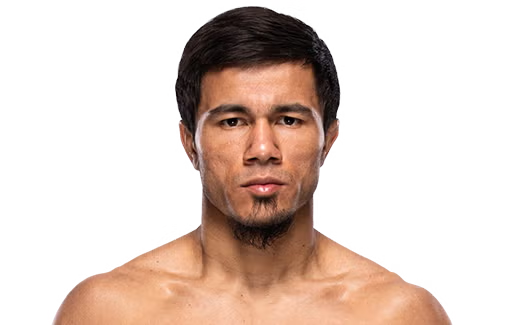
limited sample · 5 UFC fightslimited · 5 fights
Style Matchup
provisional · 3 UFC fightsprovisional · 3 fights
STRIKING
P51
Striking Initiative
P97
P63
Volume
P97
P81
Striking Efficiency
P70
P85
Range Sniper
P95
P79
Kickboxing
P74
P34
Clinch Striking
P28
P43
Defensive Striking
P86
GRAPPLING / WRESTLING
P46
Wrestling
P38
P59
Pressure Wrestling
P10
P38
Top Control
P9
P20
Submission
P4
P70
Anti-Wrestling
P58
P74
Grappling Defense
P83
P52
Scrambler
P28
DAMAGE / FINISHING
P55
Power
P100
P7
Finisher
P48
P56
Damage Resistance
P60
· style, not skillFIGHT DYNAMICS· style, not skill
P14
Fast Starter
P76
P27
Pace
P34
P14
Late Fighter
P42
GLOBAL
P66
Versatility
P47
Current fighter profiles · percentiles vs current established UFC fighters (8+ fights).
Striking
KavanaghTemirov
4.10Landed / min4.73
3.94Absorbed / min3.65
50%Accuracy41%
54%Defense62%
0.19KD / 153.38
0.19KD abs / 150.00
Grappling / Wrestling
KavanaghTemirov
1.15TD / 150.68
2.49TD att / 151.35
46%TD accuracy50%
83%TD defense100%
1:51Control / 150:23
0.38Sub att / 150.00
Targets
KavanaghTemirov
Head57%|81%
Body25%|17%
Leg18%|2%
Position
KavanaghTemirov
Distance80%|87%
Clinch8%|9%
Ground12%|5%
Ranking evolution Kavanagh Temirov
AI Matchup Analysis
Generated by an LLM from structured matchup data. It does not determine the model's win probability.
Lone'er Kavanagh
Lone'er Kavanagh carries a 10-2 all-organizations mark and a 3-2 UFC run, his last win coming over the No. 5-ranked opponent. He owns a 10 cm reach advantage and a frame to work behind it, and he's hard to hold down, scrambling back to his feet when taken to the mat.
Ramazan Temirov
Ramazan Temirov arrives on a 12-fight win streak, 20-3 overall and 3-0 in the UFC with his last victory over the No. 10-ranked opponent. His recent run shows real knockout power and finishing momentum, and he's shown sharp distance management and solid stand-up defense against quality competition.
Matchup Read
Temirov brings the longer winning streak and the stronger recent results against ranked names, but Kavanagh owns the matchup-specific physical tools. The 10 cm reach gap lets Kavanagh fight at range and contest Temirov's striking, though Temirov's power and defensive sharpness make those exchanges dangerous. If Temirov looks to close and land flush, Kavanagh's ability to scramble up off his back keeps him from being pinned and worn down.
What to Watch
- Early striking: whether Kavanagh can use his length to keep Temirov at the end of his range or gets drawn into close exchanges.
- Grappling: if the fight hits the mat, how quickly Kavanagh works back to his feet.
- Power moments: whether Temirov finds the flush counter that has been ending his recent fights.
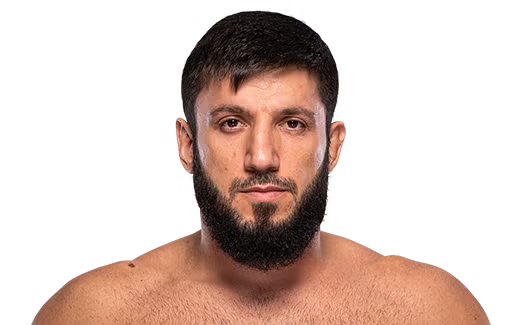
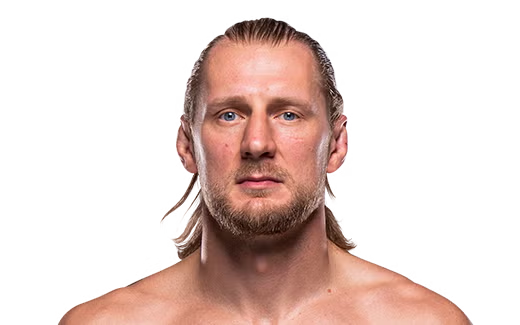
provisional · 3 UFC fightsprovisional · 3 fights
Style Matchup
established · 19 UFC fightsestablished · 19 fights
STRIKING
P70
Striking Initiative
P98
P66
Volume
P94
P72
Striking Efficiency
P99
P54
Range Sniper
P90
P58
Kickboxing
P98
P92
Clinch Striking
P30
P26
Defensive Striking
P61
GRAPPLING / WRESTLING
P16
Wrestling
P36
P16
Pressure Wrestling
P5
P62
Top Control
P14
P14
Submission
P35
P25
Anti-Wrestling
P32
P82
Grappling Defense
P58
P27
Scrambler
P37
DAMAGE / FINISHING
P67
Power
P61
P45
Finisher
P55
P64
Damage Resistance
P86
· style, not skillFIGHT DYNAMICS· style, not skill
P11
Fast Starter
P95
P50
Pace
P43
P18
Late Fighter
P15
GLOBAL
P50
Versatility
P92
Current fighter profiles · percentiles vs current established UFC fighters (8+ fights).
Striking
KunievVolkov
3.74Landed / min5.08
2.60Absorbed / min3.06
48%Accuracy58%
48%Defense54%
0.36KD / 150.24
0.00KD abs / 150.12
Grappling / Wrestling
KunievVolkov
0.00TD / 150.61
0.00TD att / 150.98
—TD accuracy63%
92%TD defense69%
3:25Control / 151:24
0.00Sub att / 150.12
Targets
KunievVolkov
Head75%|59%
Body23%|22%
Leg3%|20%
Position
KunievVolkov
Distance60%|84%
Clinch40%|8%
Ground1%|7%
Ranking evolution Kuniev Volkov
AI Matchup Analysis
Generated by an LLM from structured matchup data. It does not determine the model's win probability.
Rizvan Kuniev
Kuniev comes in on a 2-fight win streak with a 14-3 overall mark and 2-1 in the UFC, his last win over the No. 22-ranked opponent. His recent fights carry real finishing momentum and knockout power, with striking volume trending upward, and he's shown he can defend takedowns to keep things standing.
Alexander Volkov
Volkov brings a deep 40-11 record and 14-5 UFC mark, winning four of his last five, most recently over the No. 8-ranked opponent. He owns a sizeable frame with a 10 cm reach advantage, and his striking carries a slight edge in volume and sustained pressure.
Matchup Read
Early on, Kuniev's recent power and finishing threat make the opening exchanges dangerous for Volkov, especially if he can close the 10 cm reach gap and get inside. Stretch the fight out, though, and Volkov's length and higher output let him fight behind his jab and accumulate from range. Kuniev's takedown defense keeps this standing, which plays into the striking battle where Volkov's reach and pressure set the terms.
What to Watch
- Early striking: whether Kuniev can breach the reach gap and land with the power he's shown in recent fights.
- Range control: how well Volkov keeps Kuniev at the end of his jab and dictates distance behind his length.
- If it drags on: does Volkov's volume and pressure start piling up as the fight extends past the first exchanges.
Style DNA
Understand the styles behind the matchup.
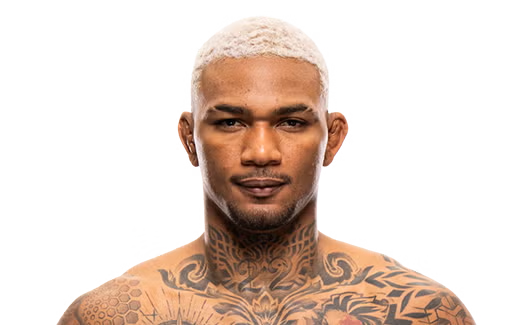
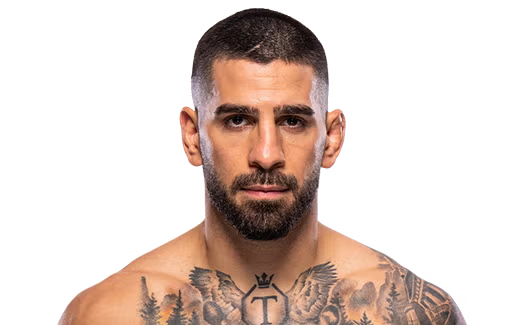
See how fighters differ across striking, wrestling, control, defense, finishing and fight dynamics.
Track Record
Walk-forward results, bankroll evolution and the complete history of previous UFC events and model predictions.
+15.03%
ROI
Return on Investment
- Total profit divided by total amount staked, over the bets and date range currently selected.
+174.1u
Net Profit
Net Profit
- Total profit or loss in units over the selected bets and date range, using the staking rule set in the Strategy Backtest.
−15.4u
Max Drawdown
Max Drawdown
- The largest peak-to-trough decline in the resimulated bankroll over this window, in units.
65.2%
Accuracy
Accuracy
- Measured only on the bets that were actually placed (betting rule met and model probability at or above the threshold), not on every prediction the model made.
0.207
Brier Score
✓ Better than marketBrier Score
- Lower is better. Measures how well-calibrated the model probabilities are.
- Computed on the bets that were actually placed, not on every prediction the model made.
1066
Bets Placed
Bets Placed
- Number of individual bets that passed the selection rule (betting rule met and model probability at or above the threshold) within the selected date range.
Monthly expanding-window backtest. The model is retrained each month using only information available before the prediction period.
Walk-forward schedule
- Train: 2012–2021 → Test: January 2022
- Train: 2012–January 2022 → Test: February 2022
- ...and so on, expanding the training window by one month each time
Opening vs closing odds
- Opening: bets are selected and settled at Pinnacle's opening price.
- Closing: bets are selected and settled at Pinnacle's closing price, the sharpest benchmark available.
- The selected bets can differ between the two, since the edge is computed against the chosen price.
Staking
- Starting bankroll: 10 units.
- Compound: 10% of the current bankroll per bet (min 0.5u, max 5u), scaled by the confidence tier.
- Flat: 1 unit per bet, scaled by the confidence tier.
Minimum model probability
- The official strategy uses a 50% floor. Higher values simulate stricter selection criteria. See the About page for the full rule and why "model-favored" isn't the same as "market favorite".
≥%
✓50%
✓55%
✓60%
✓65%
✓70%
✓75%
✓80%
✓85%
✓90%
→
Bankroll Evolution
Opening oddsClosing oddsStart (10u)